
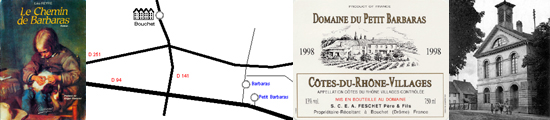


Ancient Village of Barbaras in the Middle Ages
The village of Barbaras, active in the Middle Ages, does not seem to exist officially anymore but is listed on some maps. During the Middle Ages trade took place between Avignon and Barbaras over the "Barbaras Route". It is described in the introduction of a novel of the same name ("Chemin du Barbaras"); I am trying to get a copy of the book so I can get more details. It certainly seems a possibility that the family name was derived from that of the town.
Guy Barbaras sent me an article* about nearby Suze-la-Rousse which contains the following passages mentioning the village of Barbaras:
Guy Barbaras sent me an article* about nearby Suze-la-Rousse which contains the following passages mentioning the village of Barbaras:
"Suze-la-Rousse...Its origin subsequent to the Roman domination of Gaul didn't come back beyond the second period of the Middle Ages; it was born of an imperial need, that of an efficacious protection against pillaging and anarchy. Suze formed a community having a counsel, general assemblies, and consuls...
The royalties, the taxes on the inhabitants, the duties collected in Suze for the benefit of the lord's tax collector were enumerated in an official declaration drawn up by William of Baume... Then came the enumeration of the fiefs situated within the jurisdiction and not annexed to the barony of Suze but belonging to the same family. The oldest was named Barbaras; it was a fertile area of farms held by sharecropppers organized under a special distinct jurisdiction encompassing the land belonging to it. In 1210, it was ceded to William of Baux by the Count of Toulouse as an homage (ed. Webster's Third New International Dictionary defines homage as 'a feudal solemn public ceremony by which in return for a fief (as a tenancy of land) a man acknowledges himself the man or vassal of the lord'). The upper domaine passed to Phillipe-the-was and from that prince to the court of Rome; the coexistence of another fief of the same name, near Courtaison, renders upon the history of Barbaras an obscurity from which it is not always easy to triomph. Incorporated under the aegis of the house of Suze, Barbaras remained tithed to the bishops of Saint Paul, following a treatise put together in 1259 by Fédide, Raymond de Baux's daughter, and abbess in the monastery of Bouchet. Not far from the small sharecroppping farms, a chapel was built in honor of Saint-Queuin, bishop of Vaison. In the final days of the year 1045, an assembly, convened there under the name of the council of Barbaras, created a great stir."
* title unknown; ISBN-2-86971-232-4The royalties, the taxes on the inhabitants, the duties collected in Suze for the benefit of the lord's tax collector were enumerated in an official declaration drawn up by William of Baume... Then came the enumeration of the fiefs situated within the jurisdiction and not annexed to the barony of Suze but belonging to the same family. The oldest was named Barbaras; it was a fertile area of farms held by sharecropppers organized under a special distinct jurisdiction encompassing the land belonging to it. In 1210, it was ceded to William of Baux by the Count of Toulouse as an homage (ed. Webster's Third New International Dictionary defines homage as 'a feudal solemn public ceremony by which in return for a fief (as a tenancy of land) a man acknowledges himself the man or vassal of the lord'). The upper domaine passed to Phillipe-the-was and from that prince to the court of Rome; the coexistence of another fief of the same name, near Courtaison, renders upon the history of Barbaras an obscurity from which it is not always easy to triomph. Incorporated under the aegis of the house of Suze, Barbaras remained tithed to the bishops of Saint Paul, following a treatise put together in 1259 by Fédide, Raymond de Baux's daughter, and abbess in the monastery of Bouchet. Not far from the small sharecroppping farms, a chapel was built in honor of Saint-Queuin, bishop of Vaison. In the final days of the year 1045, an assembly, convened there under the name of the council of Barbaras, created a great stir."