


Past and Present of Lake County, Illinois (Wm. Le Baron & Co., 1877)
George Barbaras was appointed Postmaster of Ela, Illinois on 24 Feb 1857."History of Rice County" (pub. 1882)
The actual settlement of this town commenced in June, 1854, when a party of Germans, who had stopped for a short time in Illinois, made their appearance, having come with ox teams and been four weeks on the road... Jacob Blank was the first to make a claim, and drove his stakes in sections 15 and 22, immediately commencing improvements. He had brought with him a pair of steers and two cows that he used in the yoke, and he at once put up a little hay shanty to live in; in this same little hay hut the first child born in the township first saw the light. In the fall Blank built a log house into which he moved that winter. As he could not buy any lumber he had to manufacture it himself... Frederick Knauss (ed. husband of Ellen Barbaras) built his castle in section 23, which he still holds."Early Pioneers and Indians of Minnesota and Rice County"
by Lillie Clara Berg (pub. 1959)
Wheeling Township...is mostly all prairie land... settlement commenced in 1854, when a party of Germans, who had stoppped for a short time in Illinois, made their appearance, coming with ox teams and being on the road four weeks... They intended going to Mankato but when they came this far, the woods became so dense, and the mosquitoes so bad that the already exhasuted oxen could go no further... They all made claims in the township.by Lillie Clara Berg (pub. 1959)
"History of Dakota County" (pub. 1881)
George Barbaras, a native of France, was born September 14th, 1832. His early education was received in France and Germany. Came to America in April 1847, and located near Chicago, being engaged in farming until 1861, then came to Dakota county, Minnesota, and settled in the township of Vermillion. He continued farming until 1869, then removed to hastings. Was assistant cashier in the Farmer's and Trader's bank for four years; was justice of the peace four years, and was admitted to the bar in June, 1874, by Judge Crosby. He has been active in practice since...(pg. 230) George Barbaras listed in the Dakota County bar in 1880. (also Lorenzo VanSlyck, who is city attorney)
(pg. 276) Alderman in Hastings 1874 & 1875, Mayor 1876 & 1877
(pg. 285 Treasurer of Vermillion Royal Arch Chaper No. 2
(pg. 187) VP of Hastings Union Industrial Association
(pg. 479) School District 37 organized in Vermillion Township in 1863. George Barbaras was treasurer. School was held in a granary belonging to George Barbaras. It was a frame building and covered with hay; a nboard was taken out, the aperture serving as a window. At the start there were but three or four scholars, with Mary Hawkins as teacher.
"History of Dakota County" (pub. 1910)
(pg. 220) On the Dakota County bar in 1880. (pg. 257) City Hall was built in 1884 for $3,500. George Barbaras was chairman of the building committee and on the town council.
"Rice County Families: Their History, Our Heritage" (Rice County Historical Society pub. 1981)
Michael Bollenbach
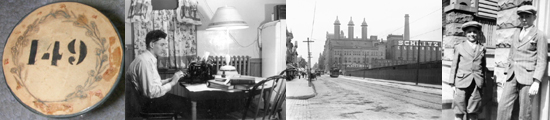
John Bollenbach and Henrietta Meyers were married in the early 1830's in Ostheim, Alsace Lorraine, France. Their eldest son, Michael John Bollenbach, was born August 16, 1832 in Ostheim. He died on May 27, 1911 in Palatine, Illinois. Henrietta was concerned over the military status of her son Michael. The young men who drew even numbers were required to serve, and those who drew the odd numbers were free of obligation. On the appointed day of the drawing and unbeknown to young Michael, his mother sewed a four leaf clover in the shirt cuff of his right sleeve. Michael drew number 149. He came to the United States in 1853, worked his way west, and settled in Long Grove, Illinois. His parents followed in 1854.On March 9, 1858 he married Magdelena Barbaras, born May 4, 1839 and died May 19, 1917 in Palatine, Illinois. To this union eight children were born, the third being Charles John Bollenbach born February 24, 1865 at Long grove, Illinois and died February 6, 1947 at Nerstrand, Minnesota.
The Barbaras family owned the land in Wheeling, Cook County, Illinois that became the Bollenbach homestead. Michael was called to serve in the Civil War, but since he had a family of young children the Barbaras paid his brother Charles, who was a blacksmith to serve in his place. Thus, in his honor the third child born in 1865 was christened Charles John Bollenbach. He attended school in Long Grove ... In 1866 he came to Rice County, Minnesota where he worked for farmers in the Dennison and Nerstrand area.